Where things stand
What has actually happened in recent months, without exaggeration and without doom.
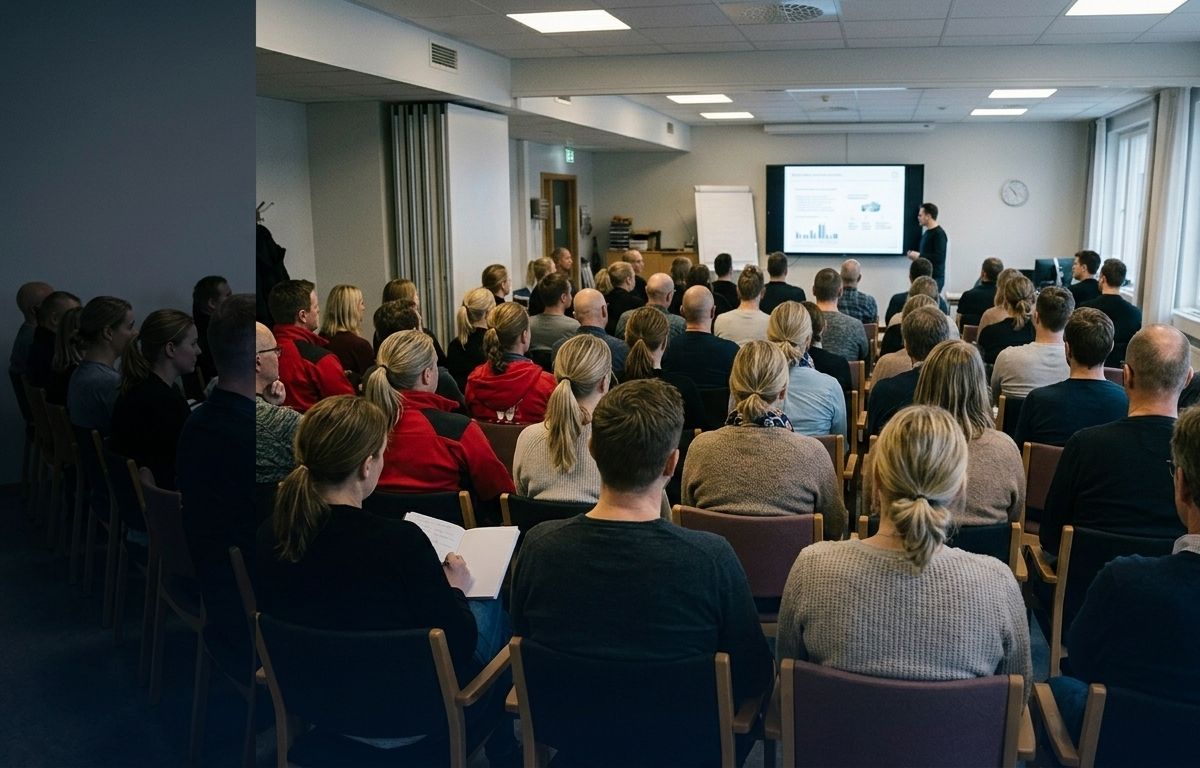
What a talk does
For a workplace where the worry is greater than the knowledge, a talk is the right first step, because a whole staff group needs the same picture of the situation before anyone can start working differently.
One to three hours is enough for a whole staff group to understand what is happening, what is exaggerated and what actually touches their work. It is not enough for anyone to use a tool in their own work afterwards, because nobody gets to practise.
We say so plainly, because then the expectations are right. The talk answers a different question from the workshop: it is about what it means, not about how it is done.
What has actually happened in recent months, without exaggeration and without doom.
The same content, angled towards your sector or your part of the public sector. The examples are taken from your organisation.
Three or four things that can be tried the same week, without anyone having to buy anything new.
Who is listening, what they do, what is sensitive to raise.
The main part of the time, built around examples from your organisation.
Ten to twenty minutes, sometimes more when time allows. This is often where the real conversation begins.
Length: usually one to three hours, questions included. Number of participants: no upper limit, unlike the workshop. On site or online.
You need a projector or a screen and the ability to show an image. Online, your ordinary meeting tool is enough.
The preparation is small and it is ours: one conversation, and preferably two or three examples of what your employees actually do all day.
Common questions about AI lectures
The price of an AI lecture is set per assignment, and a few things govern it. How many people are to listen, and whether it is one occasion or several when everyone cannot fit in at the same time. How long the lecture is to be and how much time is set aside for questions. Whether it is held on site with you or online, and in the case of a visit, how far we travel. How much preparation is included, meaning how hard the content is angled towards your sector or your part of the public sector. Tell us what it looks like with you and we will work it out.
Yes. AIUC submits tenders in public procurements and delivers on call-offs. Tell us how you buy and we will say what is required from our side.
An AI lecture has no upper limit on how many can listen, unlike a workshop where the group has to be kept small. It works just as well for one department as for a whole conference, on site or online. Tell us how many you are and in what room, and we will say what is needed for everyone to hear and see.
An AI lecture gives a whole staff group the same picture of where things stand: what has actually happened, what is exaggerated, and what touches their own work. It suits the situation where the worry is greater than the knowledge, because everyone needs the same starting point before anyone can start working differently. Participants do learn a good deal about where things stand, but they get no practice in using a tool on their own work tasks, and that is the whole point of the format.
No, and we do not promise that. An AI lecture changes how the group thinks about AI, which is often what is missing. Changing how they work requires them to try it themselves, and then a workshop is the right format. We say so plainly in the conversation beforehand, because that way the expectations are right.
Yes. AIUC delivers keynotes at conferences, kickoffs and internal events, and an AI keynote speaker from us is briefed on your sector before the day so that the examples come from your own working week rather than from a generic slide deck. A keynote is usually between one and three hours including questions, and the question session is often where the real conversation begins.
An AI seminar or lecture answers what it means. Everyone listens, no one has to keep up with a practical exercise, and there is no upper limit on how many can take part. A workshop answers how you do it. Participants sit with their own tools and their own work tasks, the group has to be kept small, and it is the format to choose when people have to be able to do something concrete the next day. Many organisations start with the lecture and follow it with workshops for the groups whose daily work changes most.
Yes, and it is the most common situation. An AI lecture handles mixed prior knowledge better than a workshop does, because nobody has to keep up with a practical exercise. The experienced user gets an updated picture of where things stand and the beginner gets the words to talk about it, and the question session afterwards picks up what separates them.
Yes. An AI lecture works online, because the format does not depend on anyone standing beside the participants and watching them work. Online is the right choice when the staff are spread across several locations, or when the occasion needs to happen quickly, and your ordinary meeting tool is enough. On site you gain the question session, which is often where the real conversation begins.
For an AI lecture on site you need a projector or a screen and the ability to show an image. Online, your ordinary meeting tool is enough. The preparation is small, and it is ours: one conversation about who is listening, what they do and what is sensitive to raise, and preferably a few examples of what your employees actually do all day.
An AI lecture is usually between one and three hours, questions included. How long it runs is decided by how much has to fit and how much time you want for questions, and that is settled in the short check-in beforehand. The format is meant to fit into a conference, a staff meeting or a kickoff without anyone having to take a whole day out of production.
AI Utbildningscentrum (AIUC) gives AI talks for government agencies, municipalities and companies across Sweden, on site or online, in English or Swedish. A talk is one to three hours and built around examples from your own organisation, so that the audience recognises its own work. The talks are given by Andreas Olsson, founder of AI Utbildningscentrum. If it concerns the management team, there is a separate half day, AI training for managers.