Rewrite a draft until it is good enough
Getting from a half-decent answer to a useful one by changing the instruction, not by giving up.
What a workshop does
For a group that needs to do something concrete the next day, a workshop is the right format, because no one learns to handle their own work tasks by watching someone else do it.
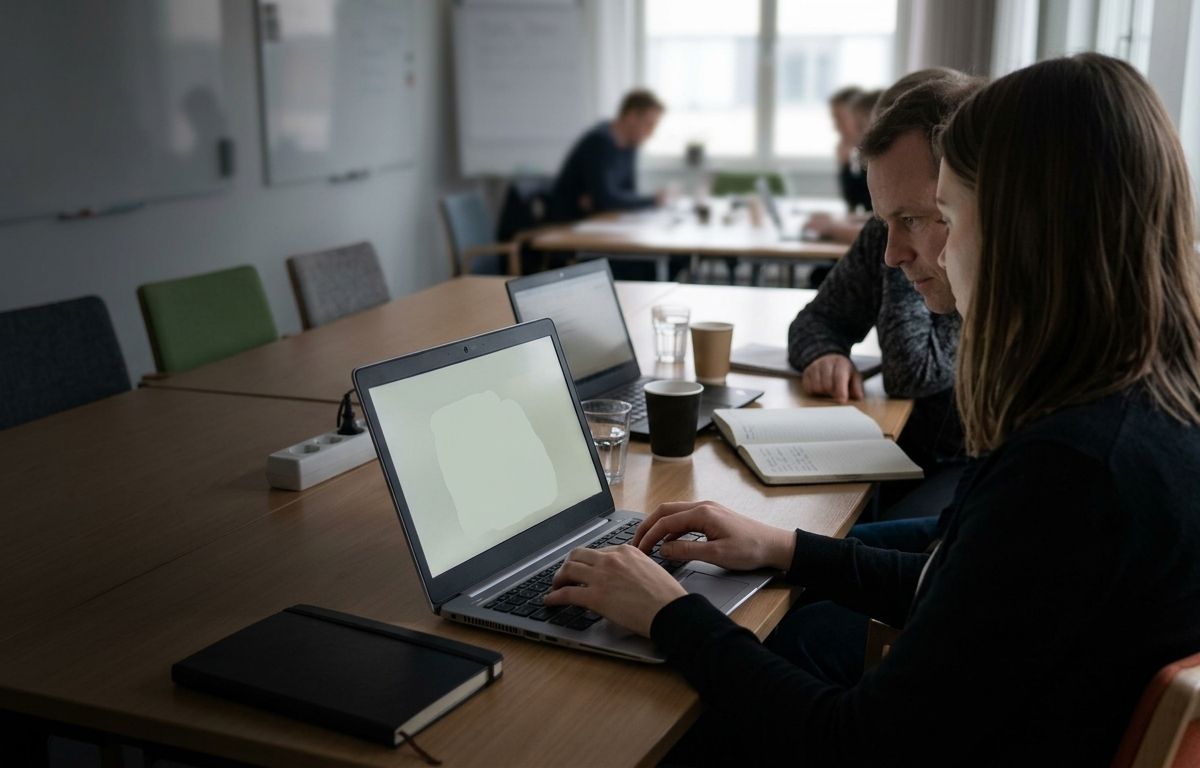
The workshop is hands-on all the way through. Participants sit with their own tools, their own tasks and their own texts, and we stand beside them when things go wrong.
The tools and examples are chosen in advance. We start from what you already hold a licence for, and the exercises are built on work tasks we have taken from your organisation during the preparation.
If the whole staff is to be reached and not just one group, we combine the workshop with online training for breadth. That is the most common arrangement in organisations with more than a hundred employees.
Getting from a half-decent answer to a useful one by changing the instruction, not by giving up.
And knowing how to check that nothing important was dropped.
Which tasks do not belong in an AI tool, and why.
The tools and examples are chosen before the day begins. That is what makes the time enough.
Enough for everyone to share the same words.
Everyone does the same task at the same time. This is where we find out where the group actually stands.
Participants work on what they brought with them. We move around the room.
What must not be entered, and how to quality-assure what comes out.
Each person formulates one thing they will do next week.
The size of the group is set for each assignment, and we keep it small enough that we have time to stand beside each person when things go wrong. That is the whole point of the day, and it stops working in a large group.
If you are more than that, we would rather split the group and run two days than keep a pace that suits half the room.
The practical exercises run in our own lab environment. Participants need neither install anything nor create accounts. They click a link and are under way. If you also want to work in your own tools during the day, the licences need to be in place, and we confirm that well in advance.
We need two things from you: a room where everyone has their own screen, and participants who bring a real work task with them.
The preparation is greater here than for a talk. It is also ours to do. We gather what we need in the conversation beforehand.
Common questions about AI workshops
The price of an AI workshop is set per assignment, and a few things govern it. How many participants there are, and whether the group needs to be split across several sessions. How long the day is to be. Whether it is run on site with you or online, and in the case of a visit, how far we travel. How much preparation is included, meaning how deeply we go into your work tasks beforehand in order to build the exercises on them. Tell us what it looks like with you and we will work it out.
Yes. AIUC submits tenders in public procurements and delivers on call-offs. Tell us how you buy and we will say what is required from our side.
The group size in an AI workshop is set per assignment, and it is kept small enough that we have time to stand beside each person when things go wrong. That is the whole point of the day, and it stops working in a large group. If you are more than that, we would rather split the group and run several sessions than keep a pace that suits half the room. When the whole staff is to be reached, the workshop is combined with online training for breadth.
An AI workshop is hands-on all the way through: participants sit with their own tools and their own work tasks, and it answers the question of how you do it. A lecture answers a different question, namely what it means, and it teaches no one to do anything. If a whole staff group is to get the same picture of where things stand, the lecture is right. If a group has to be able to do something concrete the next day, the workshop is right.
After an AI workshop, participants can rewrite a draft until it is good enough by changing the instruction instead of giving up, summarise a document without losing what matters and check that nothing was dropped, and judge which tasks do not belong in an AI tool. Before the day ends, each person also formulates one thing to do the following week.
A workshop reaches one group at a time and goes deep. When the whole staff is to be reached, the usual arrangement is to combine formats: an AI workshop for the groups whose daily work changes most, a talk that gives everyone the same picture, and online training that reaches the rest at their own pace. That is the most common arrangement in organisations with more than a hundred employees. Every participant gets a record of completion, and the organisation gets a delivery log of what was done and who took part.
Yes. An AI workshop online runs in the same lab environment as on site: participants click a link and work on their own tasks exactly as they would in a room. Online is the right choice when participants are spread across several locations, or when the day needs to happen quickly. On site you gain something else, namely that we see over the shoulder and pick up the person who is stuck without saying so. Tell us how you are placed and we will say which one we believe in for your group, and if we do not think a trip is worth the money we will say that too.
For the exercises in an AI workshop you need nothing: they run in our own lab environment and participants click a link without installing anything or creating accounts. If you also want to work in your own tools during the day, the licences need to be in place, and we confirm that well in advance so that no hour is spent on logins. From you we need a room where everyone has their own screen, and participants who bring a real work task with them.
The preparation for an AI workshop is greater than for a lecture, and it is ours to do. We gather work tasks from your organisation in the conversation beforehand and build the exercises on them, and we start from the tools you already hold a licence for. That is what makes the time enough during the day, because nothing is chosen while everyone waits.
That is the most common situation, and it is solved during the preparation. Before an AI workshop we find out where the group stands, and if the spread is too wide we would rather split the group and run several sessions than keep a pace that suits half the room. The day also opens with a shared exercise that everyone does at the same time, and that shows immediately where the group actually stands.