For your organisation
AI training for organisations: skills your staff use afterwards
AI Utbildningscentrum (AIUC) builds AI training for companies, government agencies and municipalities across Sweden on your actual tasks, and measures what the group can do before and afterwards. You choose the format: at your offices, live online or self-paced. You get a log of what was delivered and two assessments.
Where we start
We start with the person who will be sitting in the room
For an organisation that needs to raise the whole staff's practical grasp of AI and at the same time be able to show what was done, the delivery and the documentation need to come from the same place. You choose the format: at your offices, live online or self-paced. What does not vary is that what was done can be shown.
Training that does not land with the employee has not happened, whatever the invoice says. So the first thing we ask is who is to be trained and what they actually do all day.
That matters in practice. A case officer who has never written a prompt needs something different from a communications officer who has used ChatGPT for two years, and the two are often in the same room.
We adapt language and pace to the group, and we hold the training in English when English is the working language. These are not separate products. It is how we deliver.
International organisations in Sweden
When Swedish is not the language your staff work in
A good part of what we deliver is held in English. International companies with a Swedish office, organisations setting up operations here, embassies and trade offices, and leadership teams spread across the Nordics.
For those organisations the language is rarely the hard part. The harder part is that the staff work under Swedish conditions while the company's own AI policy was written somewhere else, and the two do not always say the same thing.
So we hold the training in English and keep the Swedish context. How the EU AI Act's AI literacy requirement lands on an operation established here. What a Swedish public-sector client will ask you to document if you sell to one. Where a Swedish workplace's expectations differ from a global policy.
We come to your office anywhere in Sweden, or hold it online when the group sits in several countries. It is not a separate product. It is how we deliver.
Before we arrive
The preparation is ours
You do not need to prepare the group, produce material or solve anything technical. What we need from you fits in one conversation.
- 1
We find out who will be in the room
What they work on, what they already know, and who in the group is sceptical. The last one is often the most important.
- 2
We read up on your organisation
What is going on with you right now. A new law, a system change, a workload peak waiting in the autumn. That decides which examples land and which bounce.
- 3
We build the exercises from your own tasks
Participants work on things they recognise from their own week. That is the difference between understanding and being able.
- 4
We make sure the technology works
Participants need neither install anything nor log in anywhere to get started. We solve that before we arrive.
How the content is built
Five layers. Two of them are yours.
Foundation
What generative AI actually is and is not, where it tends to go wrong, and how to write an instruction that gives you something useful. Everyone goes through this layer. How deep it goes depends on what the group already knows.
Tools
We train in the tools you already pay for. If you have Copilot, it is Copilot. Chosen according to your licences.
Workflows
The exercises are built on your own tasks. An officer's report, a set of procurement documents, the minutes of a meeting. Taken from your organisation.
Safe use
Confidentiality, quality assurance and what your own policy says. The rules are shared, the examples are yours.
Hands-on
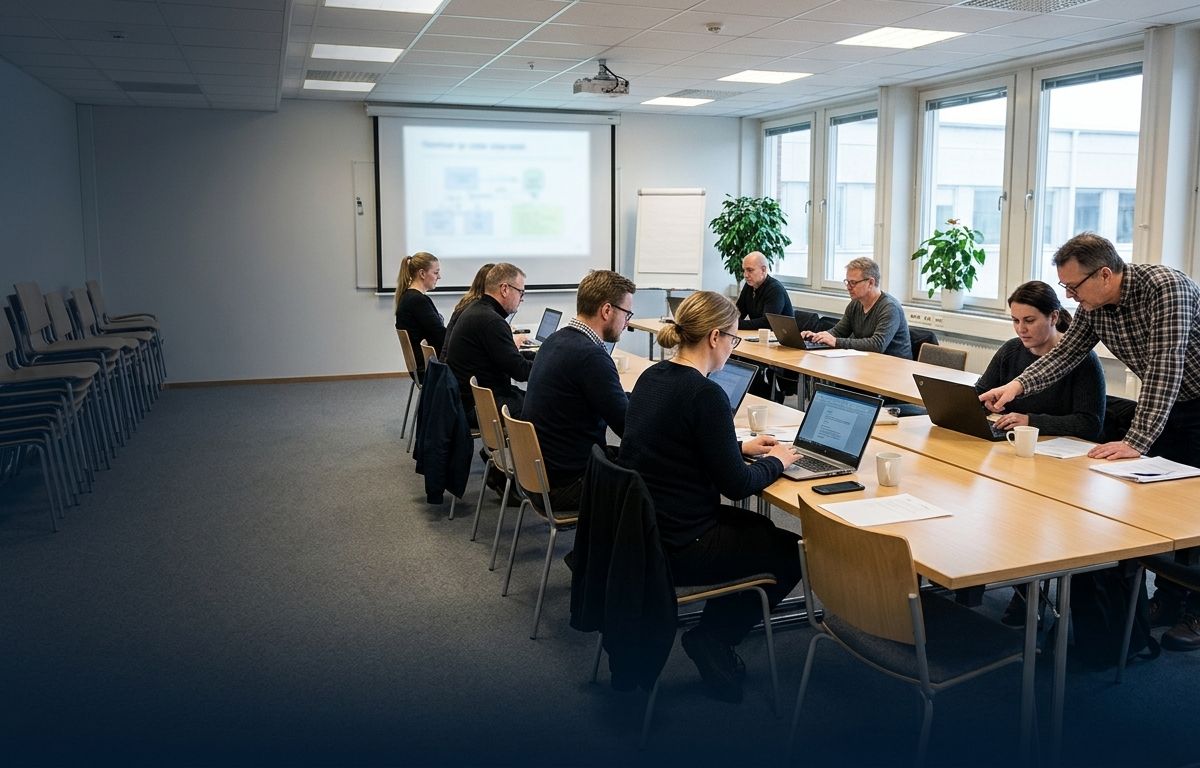
Participants work on their own tasks while we stand beside them. This is where it sticks. That layer is one we never skip.
Three of the layers are for everyone, but not at the same depth. The tools are chosen according to what you already have, and the examples are taken from your own tasks.
We train in the tools you already have. But what participants learn has to survive the tool changing its name.
Six ways to do it
Which format fits depends on what you want to achieve
Talk
One to three hours that move a group from worry to curiosity. For the conference, the staff meeting or the kickoff.
Workshop
A day where participants work on their own tasks and can do something concrete when they go home.
Training programme
Three to five sessions over eight to twelve weeks, for when it has to last.
Management team
For those of you who make the decisions and need a shared language to make them in.
AI literacy package
Role-based skills with documented delivery, for those of you who have been asked and need to be able to show what you did.
Online training for the whole staff
When it is a thousand people and not twenty. Own pace, a record of completion per participant, measurable delivery.
Afterwards
Three things remain once we have gone home
Participants get a record of completion after a workshop, a training programme or online training, issued digitally and possible to verify afterwards. A talk leaves no participant list and therefore no personal records. You get a delivery log stating what was done, who took part and when. It is written to be shown, not to be filed.
And you get a measurement in two parts. The participant assesses their own ability before and afterwards. The manager assesses the same thing about the same person.
The second part is the one that means something. A participant assessing themselves has an opinion. A manager assessing an employee has a judgement, and it was the manager who paid.
The log is the organisation's evidence, the record of completion is the individual's. Whoever has to account for what you did needs the first. Whoever changes job in three years still has the second.
What it costs
We have no price list, and this is why
The price is driven by four things that vary independently of one another: the base price for the format, how many of you there are, how much preparation you want, and whether we travel.
What an assignment costs depends mostly on which format you choose and how many of you there are. Tell us what you had in mind and you will get a figure in the conversation.
How it works
Four steps, and you decide how far we go in step two
- 1
Conversation
We go through who is to be trained, what they do and which tools you have. Half an hour is usually enough.
- 2
Preparation
We collect your tasks and build the exercises on them. Sometimes an email with three examples is enough. Sometimes we interview five employees. You decide the scope, and it shows in the price.
- 3
Delivery
The training is held, with you or online. We come to you anywhere in Sweden.
- 4
Follow-up
Participants assess themselves, managers assess their employees, and you get the log and the records of completion.
Common questions about AI training for organisations
The price is set per assignment and there is no price list. What drives it is how many people are to be trained, which format you choose, how long the training is, whether we travel to you, and how much preparation you want included. The preparation can be an email with a few examples, or interviews with employees, and the difference shows in the price. Tell us what you had in mind and you will get a figure in the conversation.
Yes. AIUC submits tenders in public procurements and delivers on call-offs. Tell us how you buy and we will say what is required from our side.
It depends on the format. A talk is about an hour and works in a full conference room. A workshop runs half a day or a whole day and works best in a group small enough that we can stand beside each participant while they work. A training programme runs over three to five sessions with the same group. When the whole staff is to be reached, online training is the format that scales, with a record of completion per participant. Group size is one of the things that drives the price, so tell us how many you are and we will say which format fits.
Six. A talk of about an hour, a workshop over half a day or a whole day, a training programme of three to five sessions, a session for the management team, an AI literacy package with role based content, and online training for the whole staff. The foundation is the same in all of them. What changes is the depth, the group and how much of the content is built from your own tasks.
AI literacy is the practical ability to use AI in your own work and to judge when the output cannot be trusted. Raising it across a whole staff usually means combining formats: a talk that moves the room, workshops for the groups whose daily work changes most, and online training that reaches everyone else at their own pace. Participants get a record of completion in the formats where they work themselves, and the organisation gets a delivery log stating what was done and who took part, whichever format was used.
The requirement is to take measures and be able to show them, not to guarantee a particular level for every employee. That is why every assignment leaves behind a delivery log of what was done and who took part, plus a record of completion per participant in the formats where they work themselves. The AI literacy package is built for exactly that question. What the regulation requires legally of your operations is covered by Ampliro.
No, and no one can issue one today. A certification is issued by an independent body against an established standard, and no harmonised standards under the EU AI Act have been published yet. Anyone promising an AI licence under the regulation is promising something the law does not yet contain. After AI training with us, each participant gets a record of completion showing what they went through and when, which can be verified afterwards.
That is often exactly when it is needed. The licence is bought, a few people use it every day and the rest tried it once. We train in the tool you already pay for, with your own tasks as the exercises, so that more than the already confident get use out of the licence.
A recording cannot answer why your particular draft came out wrong. On site, the participant works on their own task while we stand beside them, and that is where it sticks. Online training is the right choice when the whole staff is to be reached, and the two formats are often combined.
Yes. We hold AI training in English for international groups and for organisations whose working language is English, and in Swedish when that is the working language. It is not a separate product, it is part of how we deliver.
We come to you, and that is usually better because the group is then sitting in its own everyday setting. The training can also be held online when participants are spread across several locations. Travel is one of the things that affects the price.
Yes. We adapt language and pace to the group, and we would rather split the group than hold a pace that suits half of it. Who the inexperienced participants are is something we find out during the preparation, not on the day.
Yes, and a good part of what we deliver is held in English for exactly that situation: international companies with a Swedish office, organisations setting up operations here, embassies and trade offices, and leadership teams spread across the Nordics. We come to your office anywhere in Sweden, or hold it online when the group sits in several countries. The training is in English and the context stays Swedish, because your staff work under Swedish conditions whatever language the company policy was written in.
Usually in part, and the gaps are what the training makes visible. We go through how the EU AI Act's AI literacy requirement lands on an operation established here, what a Swedish public-sector client will ask you to document if you sell to one, and where a Swedish workplace's expectations differ from a policy written elsewhere. Whether your particular policy meets what the law requires of your operations is a legal assessment, and we do not make it. That question belongs to Ampliro.
One conversation. We need to know who is to be trained and what they work on. The preparation, the material and the technical setup are ours, and participants need neither install anything nor create accounts.
As an introduction to the tools they go a long way, and Microsoft Learn is free. What they do not do is build the exercises on your own cases, say what may be entered into the tool in your organisation, or show who has completed what. That is where training with AI Utbildningscentrum begins: participants work on their own tasks while we stand beside them, and you get a log and records of completion afterwards.