After the first session
Everyone shares the same words and has solved a real task with the tool at least once.
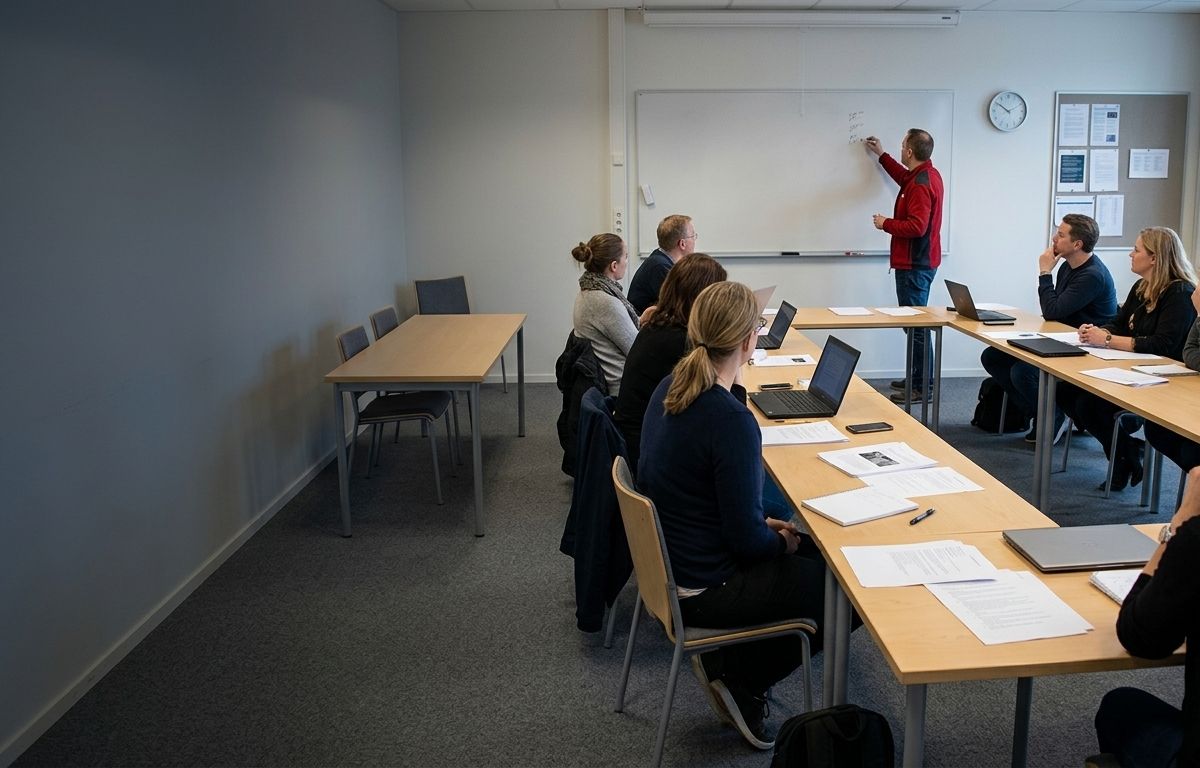
Why several sessions
For an organisation that has held a training day and watched the effect drain away, a programme over eight to twelve weeks is the right format, because the habit is built in the gaps between sessions and not in the room.
After a workshop, participants can do what they did during the day. Two weeks later, half of them have run into something that did not work and stopped trying.
The programme is built around exactly that. Between sessions, participants work as usual, and the next session starts with what went wrong. That is the only feedback that is about their real work.
Eight to twelve weeks, not eleven months. AI content that is locked down far in advance is out of date by the fourth session.
Everyone shares the same words and has solved a real task with the tool at least once.
Participants have their own routines for the tasks they do most often, and know where the tool is not good enough.
The group has shared with each other. What works for one person has spread to the others.
Everyone at the same level. A task to take home.
Participants work as usual and note down what went wrong.
We start from what went wrong and build on from there. The content is adjusted to what the group actually needs.
Quality assurance, confidentiality, and the group teaching each other.
Three to five sessions spread over eight to twelve weeks. Each session a half day or a full day. The same group all the way through.
Before the first session, each participant rates their own ability, and each manager rates their staff. After the last session, the same thing is done again.
You receive both measurements, the completion log and a record of completion per participant. The programme is the format where the measurement means the most, because it is the only one with a before and an after with time in between.
Practical elements run in our lab environment where that suits. Participants need neither install anything nor create accounts.
Common questions about AI training programs
Because AI training content that is locked down far in advance is out of date by the fourth session. A shorter AI training program can be adjusted to what has actually happened since the last time, and to what the group got stuck on.
It can be made up, but an AI training program relies on the group moving together from the first session to the last. If the absence becomes too great we will say so, because the before and after measurement assumes the same group all the way through.
Often yes, sometimes no. It is settled during the preparation, and it comes down to whether anyone dares to say that they do not understand with their manager in the room. Where the answer is no, we split the group.
The group size is set per assignment, and it is one of the things that drives the price. An AI training program relies on the same group meeting several times and sharing what worked, so very large groups are run as several parallel groups rather than one big room. If the whole organisation needs to be reached at once, online AI training is usually the better format.
It is set per assignment and there is no price list. The price is driven by how many people take part, how many sessions there are and how long they run, whether we travel to you, and how much preparation you want. An AI training program asks the most of both parties, and that shows in the price. Tell us what you have in mind and you get a price in the conversation.
Yes. The exercises are built from the everyday work of the organisation: casework, disclosure of documents, consultation responses and decision material. Between sessions participants work on their real cases, and the next session starts with what went wrong. Among those who have trained their staff with us are DIGG, the Swedish Work Environment Authority, the Swedish Chemicals Agency, the Swedish Performing Arts Agency, Vänersborg District Court, Region Stockholm, Landskrona Municipality, the Job Security Foundation, Swedavia, SAS, Angelini Pharma Nordics, CWS and Groupe Salins.
Yes. AIUC submits tenders in public procurements and delivers on call off. Tell us how you buy and we will say what is needed from our side.
Two ratings, a delivery log and a record of completion per participant. Before the first session each participant rates their own ability and each manager rates their staff, and after the last session the same thing is done again. An AI training program is the format where the measurement means the most, because it is the only one with a before and an after with time in between.
Article 4 says that those who use AI shall take measures to support the development of AI literacy among the people who work with it, and it has applied since 2 February 2025. Regulation (EU) 2026/1744 made it an obligation to make efforts rather than to guarantee a result, so what you need to be able to show is what you have done. After an AI training program there is a delivery log of what was done and who took part, plus a record of completion per participant. What the regulation requires of your particular operations is a legal assessment, and we do not make it. That question belongs to Ampliro.
The people you speak with before the assignment are the people you meet in the room, and the same people follow the group through every session. We do not hand over to anyone you have not met.